
In this article
- Key takeaways
- Jersey fabric guide: what is jersey fabric made of?
- Polyester, cotton or blends: which fibre is best for a team jersey?
- Why does sublimation need polyester?
- What are the main jersey knit types?
- What GSM should a sports jersey be?
- What finishes should a jersey fabric have?
- How do you match jersey fabric to a sport?
- Which jersey fabric suits hot and humid weather?
- How do you care for a sublimated jersey?
- How much does jersey fabric cost in India?
- How do you judge a jersey fabric swatch in your hand?
- What mistakes do teams make when choosing jersey fabric?
- Jersey fabric checklist before you order
- Fabrics in this guide

By Nishanth, founder of Jaypee Sportswear. Making custom team jerseys since 2012 at our own sublimation unit in Thanjavur. Updated 31 October 2026.
For most teams the best jersey fabric is 100% polyester knit, because sublimation only bonds to polyester. Pick Jaypee HEXA-B honeycomb mesh at ₹699 for football and heat, DOTTA-F at ₹599 for value, or LINEA-S at ₹399 for gully cricket and school days.
Key takeaways
- Sublimation needs polyester, so cotton is out for printed team kits.
- Sports jerseys usually sit between 120 and 190 GSM. Lighter is cooler, heavier lasts longer.
- The knit pattern decides airflow, print sharpness and feel more than the fibre does.
- Jaypee has 8 polyester fabrics in 4 tiers, priced at ₹399, ₹499, ₹599 and ₹699 per jersey.
- Order a swatch or a free mockup before you commit a full team order.
This jersey fabric guide comes from our factory floor in Thanjavur, where we have printed kits for hundreds of teams. It covers fibres, knit types, GSM, finishes, sport and weather matching, care and price. Read it once and you can pick a fabric without a salesman.
Jersey fabric guide: what is jersey fabric made of?
Jersey is a knitted fabric, made by looping yarn rather than weaving it. The loops are what give a jersey its stretch and softness. The name comes from the Channel Island of Jersey, and you can read the textile history on Wikipedia.
Sports jerseys are a specific kind of knit. They use a fine polyester yarn, a pattern that lets air through, and a weight that holds its shape for a full match. That is quite different from the cotton jersey a tailor uses for a casual T-shirt.
Polyester, cotton or blends: which fibre is best for a team jersey?
Polyester is the best fibre for a team jersey. It dries fast, keeps its shape and takes sublimation ink. Every Jaypee fabric is 100% polyester knit.
Cotton feels soft but soaks up sweat and stays wet. A wet cotton shirt gets heavy and clings, which is why it is a poor choice once a match starts. Cotton blends dry faster than pure cotton, but they still cannot take a full sublimation print.
Blends with elastane (the fibre sold as Lycra) add stretch. Our fabrics get their give from the knit structure, so you do not need elastane for a jersey that moves with you.
Why does sublimation need polyester?
Sublimation works only on polyester because the ink turns to gas under heat and bonds inside the polyester fibre. Cotton has no such fibre to bond with, so the dye has nowhere to go.
The result is a print that is part of the fabric. It cannot crack, peel or flake like screen print or vinyl. Our homepage promises no fading even after 100 washes, and that comes straight from this process.
It also means you can print any design edge to edge, with gradients, patterns and photo-quality logos, at no extra cost. Names, numbers and logos are already inside the price.
What are the main jersey knit types?
The main sports knit types are mesh, dot, diamond, grid, rib, rhombus and interlock. The knit pattern changes airflow, weight, print sharpness and how the shirt feels against skin.
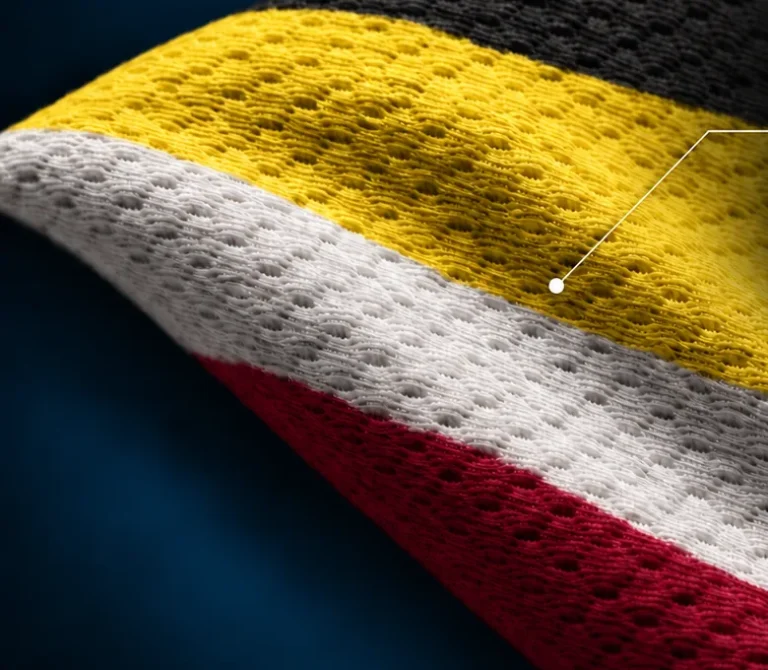
- Mesh has open cells for airflow. Our HEXA-B uses open hexagon cells, a honeycomb football mesh.
- Dot knit has small evenly spaced eyelets. DOTTA-F has a smooth face with pinhole dots, and PINDOT-N has rows of tiny pinholes.
- Diamond knit has a raised diamond texture and a structured feel. QUARTZ-A is our diamond knit.
- Grid knit has rows of tiny raised squares. GRID-E is smooth and easy to wash, and LINEA-S is a micro grid with no holes.
- Rib knit has vertical channels that stretch. RIBRA-G is a rib ladder knit.
- Rhombus knit is tight, smooth and matte, with a polo feel. RHOMB-H is a micro rhombus.
- Interlock is a double knit with loops on both faces, thick and stable. It is common in the wider market and is closest in feel to our heavier structured fabrics.
The textile world also splits knits into single jersey, with a different front and back, and double jersey, which is thicker and more stable. If you want to see how open mesh compares with a closed knit, our mesh vs knit jerseys post goes into it.
What GSM should a sports jersey be?
Most sublimated team jerseys sit between 120 and 190 GSM. GSM means grams per square metre, so it measures how much fabric is in a square metre of cloth.
Lighter fabric, 120 to 150 GSM, feels cooler and dries faster. Heavier fabric, 160 to 190 GSM, feels more structured and lasts longer through a season of washing. At 220 GSM you are in T-shirt or hoodie territory, which is too warm for most sport.
Our range runs from 140 GSM in RIBRA-G to 180 GSM in QUARTZ-A, LINEA-S and PINDOT-N. GSM alone does not tell the whole story, because a 160 GSM mesh breathes much better than a 160 GSM closed knit. Our jersey GSM explainer covers this in detail.
What finishes should a jersey fabric have?
The three finishes worth asking about are moisture-wicking, anti-microbial and UV protection. Wicking pulls sweat to the outer surface so it can evaporate. Anti-microbial treatment reduces the smell that builds up in a kit bag. UV protection helps for outdoor matches in strong sun.
QUARTZ-A, HEXA-B, DOTTA-F, RHOMB-H and RIBRA-G carry all three finishes. GRID-E, LINEA-S and PINDOT-N do not, so they are better for shorter sessions, school events and practice, where cost matters more than finish.
How do you match jersey fabric to a sport?
Match the fabric to how long and how hard your team plays. Fast, running-heavy sports need airflow. Contact and club sports need structure. Casual events need low cost.
| Sport or use | Fabric to look at | Price per jersey |
|---|---|---|
| Football, futsal, turf | HEXA-B | ₹699 |
| Finals and tournament kits | QUARTZ-A | ₹699 |
| Running singlets, gym tanks | DOTTA-F | ₹599 |
| Tennis and club polos | RHOMB-H | ₹599 |
| Kabaddi, training tops | RIBRA-G | ₹599 |
| Badminton, table tennis | GRID-E | ₹499 |
| Gully and box cricket | LINEA-S | ₹399 |
| Budget football, school houses | PINDOT-N | ₹399 |
For a full sport by sport breakdown, see jersey fabric for each sport.
Which jersey fabric suits hot and humid weather?
For hot and humid weather choose the lightest, most open knit you can afford. Thinner fabric and open cells let more air and sweat vapour pass through, which is basic physics and holds anywhere in the world.
In Chennai and across Tamil Nadu, that points to RIBRA-G at 140 GSM, our lightest premium fabric made for summer, or HEXA-B with its open honeycomb cells. Darker colours absorb more heat from the sun than light colours, so a navy kit will feel warmer than a white one in the same fabric.
We have a separate post on the best jersey fabric for Chennai weather if you want to go deeper.
How do you care for a sublimated jersey?
Wash a sublimated jersey in cold or lukewarm water, inside out, with mild detergent. Hang it to dry in shade. Because the ink sits inside the fibre, the print will not wash off, but heat can still damage the polyester itself.
Skip fabric softener, because it coats polyester and can trap odour. Skip the tumble dryer and the iron on the printed side. A kit cared for this way stays crisp for seasons.
How much does jersey fabric cost in India?
A custom sublimated jersey costs ₹399 to ₹699 at Jaypee, depending on the tier. That price includes names, numbers and logo. Every size from XS to 4XL costs the same, and bigger orders get a lower rate per piece.
| Tier | Fabrics | Price per jersey |
|---|---|---|
| Elite | QUARTZ-A, HEXA-B | ₹699 |
| Pro | DOTTA-F, RHOMB-H, RIBRA-G | ₹599 |
| Club | GRID-E | ₹499 |
| Budget-friendly | LINEA-S, PINDOT-N | ₹399 |
The minimum order is 5 pieces. Our jersey fabrics hub lists every tier with photos.
How do you judge a jersey fabric swatch in your hand?
Judge a swatch by stretching it, holding it to light and rubbing it, in that order. Each check takes about 30 seconds, and together they tell you more than a spec sheet.
Stretch the cloth both ways and let go. It should spring back flat without a ripple. Hold it up to a window to see the holes or cells of the knit, and a closed knit will look solid. Rub it on your forearm to judge the surface, since a smooth face prints cleaner and a rough face tends to pill sooner.
Then weigh the cloth with your fingers. A 140 GSM piece feels papery and cool, and a 180 GSM piece feels clearly fuller. If your supplier quotes a GSM that feels wrong against another swatch, ask for the number to be checked.
What mistakes do teams make when choosing jersey fabric?
The most common mistake is picking by price alone and then finding the kit too hot or too thin for the sport. The second is choosing a cotton-feel fabric and expecting a sublimation print on it.
Other slips we see often are ordering without a swatch, ordering one fabric for every player when goalkeepers or bowlers have different needs, and approving a design on a phone screen without checking small text. Teams also forget the weather. A kit that suits an evening match in December can feel heavy at a noon tournament in May.
A simple fix is to buy for the hardest match you will play. If that is a hot turf final, look at football jerseys in HEXA-B. If your players are school students, our school jerseys page shows the budget options.
Jersey fabric checklist before you order
Run through this list before you send a team order to any maker, including us.
- Confirm the fabric is 100% polyester if you want a full sublimation print.
- Ask for the GSM in numbers, not words like thick or light.
- Check the knit pattern against your sport and your city’s weather.
- Ask which finishes are included: wicking, anti-microbial and UV.
- Ask for a swatch so you can feel it and test a sprinkle of water.
- Check that names, numbers and logo are inside the quoted price.
- Ask for a mockup of your design before any payment.
- Confirm sizes cover every player, and whether women’s fit is offered.
- Confirm the minimum order and the rate drop for bigger quantities.
- Get a delivery date in writing, counted from design approval.
We send swatches on WhatsApp and a free mockup within 24 hours. Delivery is 7 to 10 working days after you approve the design, to Chennai, all of Tamil Nadu, India and abroad. Our buyer’s guide turns this checklist into 12 questions with answers, and the comparison chart puts all 8 fabrics side by side.
Fabrics in this guide
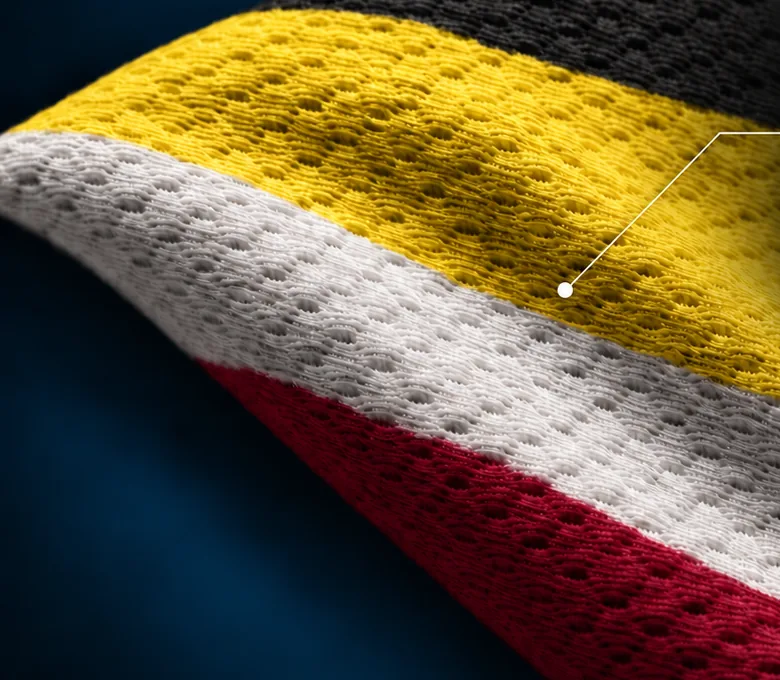 HEXA-B Football mesh, 160 GSM
₹699 per jersey with names and numbers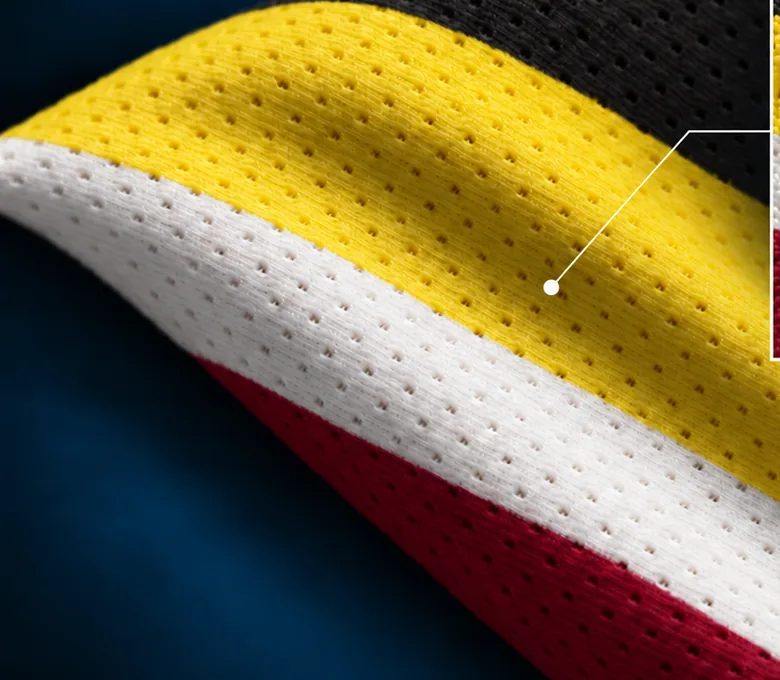 DOTTA-F Pinhole dot mesh, 160 GSM
₹599 per jersey with names and numbers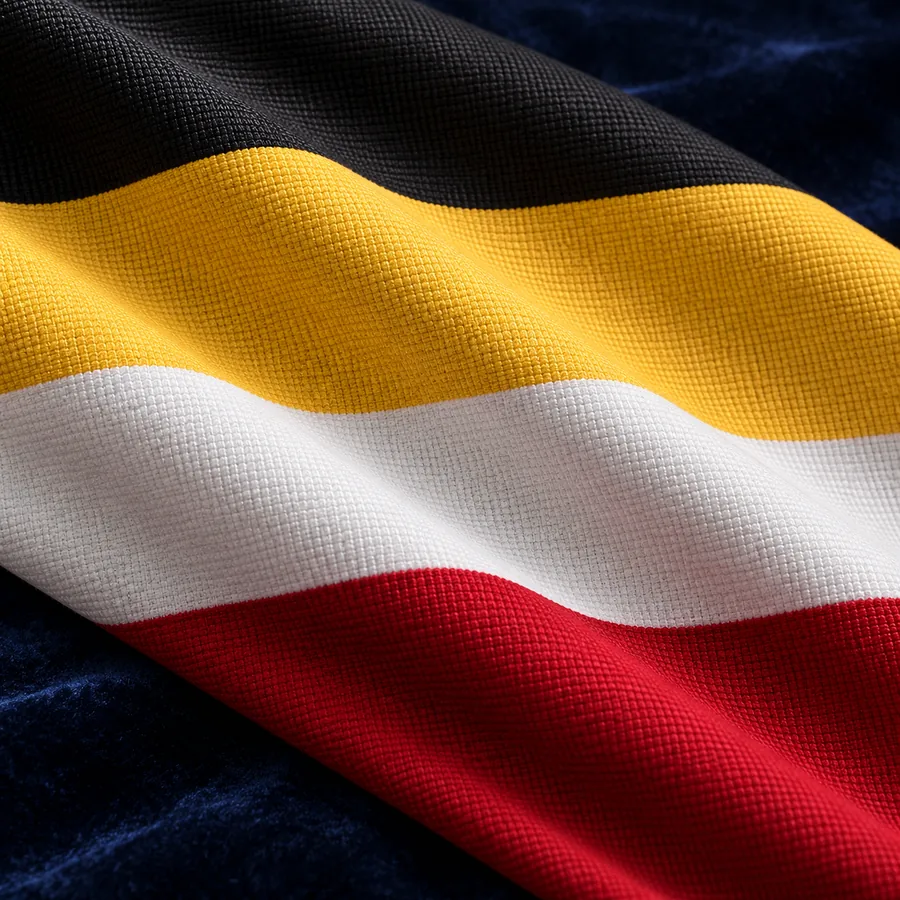 LINEA-S Micro grid knit, 180 GSM
₹399 per jersey with names and numbers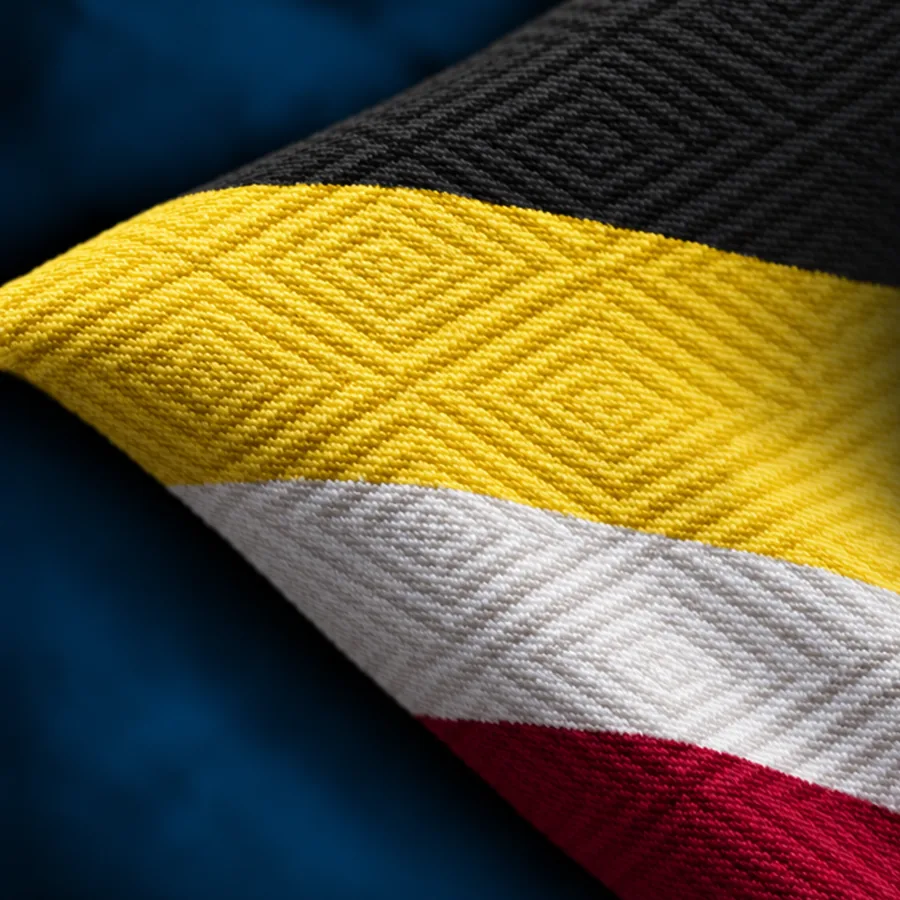 QUARTZ-A Diamond knit, 180 GSM
₹699 per jersey with names and numbers
Frequently asked questions
What is the best fabric for a sports jersey?
Polyester knit is the best fabric for a sports jersey. It dries fast, holds its shape and accepts sublimation ink. At Jaypee, HEXA-B honeycomb mesh at ₹699 is preferred for football, and LINEA-S at ₹399 suits gully cricket.
Why can't cotton be sublimated?
Sublimation ink turns to gas and bonds inside polyester fibres. Cotton has no polyester to bond with, so the ink washes out or never takes. For a printed team kit, you need 100% polyester.
What GSM is best for a football jersey?
Football jerseys usually work best between 140 and 180 GSM. Lighter, open knits like our 160 GSM HEXA-B mesh keep players cooler, while heavier knits last longer through rough play and repeated washing.
What is the difference between mesh and interlock?
Mesh has open cells that let air pass through. Interlock is a dense double knit with loops on both faces, so it is thicker and more stable but holds more heat. Mesh suits hot matches, interlock suits structure.
How much does a custom sublimated jersey cost?
At Jaypee a custom sublimated jersey costs ₹399, ₹499, ₹599 or ₹699 depending on the fabric tier. Names, numbers and logo are included, every size costs the same, and bigger orders get a lower rate.
How do I check jersey fabric quality before ordering?
Ask for the GSM and fibre content, then request a swatch. Stretch it, hold it to light to see the knit, and sprinkle water on it. Jaypee sends swatches on WhatsApp and a free mockup in 24 hours.
Get Your Free Quote
Tell us about your team kit. We send a free design mockup on WhatsApp within 24 hours.
Or WhatsApp us directly: +91 95003 97105
Watch Our Custom Jerseys
See real Jaypee Sports team kits in action. Tap to play.