In this article
- Key takeaways
- What is the best fabric for a volleyball jersey? Quick verdicts
- How do the 8 Jaypee fabrics rank for volleyball?
- What does volleyball demand from a jersey?
- Which fabric is best for indoor volleyball and which for beach or sand?
- Are sleeveless or fitted cuts better for volleyball?
- Which fabric suits setters, hitters and liberos?
- What GSM is best for a volleyball jersey?
- How should volleyball teams design the jersey layout?
- How do you care for a volleyball jersey after a match?
- How much does a volleyball squad cost?
- How do you order volleyball jerseys?
- Fabrics in this guide

By Nishanth, founder of Jaypee Sportswear. Making custom team jerseys since 2012 at our own sublimation unit in Thanjavur. Updated 31 October 2026.
The best fabric for a volleyball jersey is DOTTA-F, a 160 GSM pinhole dot mesh at ₹599 per jersey. It breathes, wicks sweat and prints team graphics cleanly. RIBRA-G at ₹599 suits fitted and sleeveless cuts, and LINEA-S at ₹399 is the budget pick.
Key takeaways
- DOTTA-F (₹599) is the best all-round volleyball fabric
- RIBRA-G (₹599) at 140 GSM suits fitted and sleeveless cuts
- HEXA-B (₹699) handles hot outdoor and sand courts
- LINEA-S and PINDOT-N (₹399) suit school teams
- Order the libero shirt in the same fabric, in a contrast colour
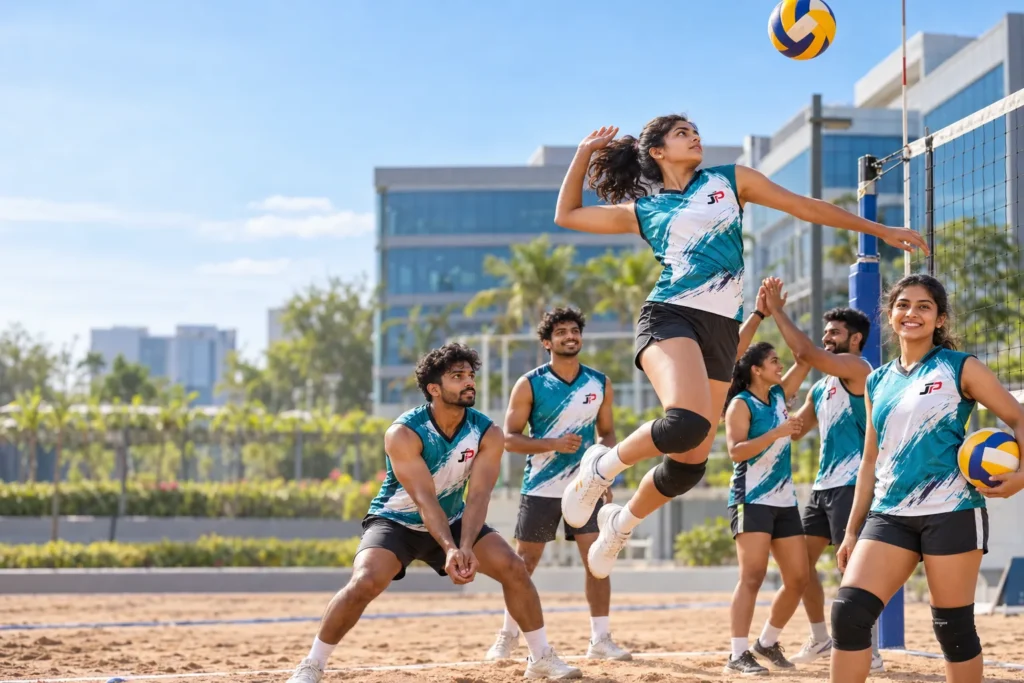
Volleyball looks gentle from the stands, but a five-set match is long, loud and sweaty, with constant jumping, diving and arm swings. This post ranks all eight Jaypee fabrics and names the best fabric for volleyball jersey orders for indoor halls, school grounds and beach or sand courts.
What is the best fabric for a volleyball jersey? Quick verdicts
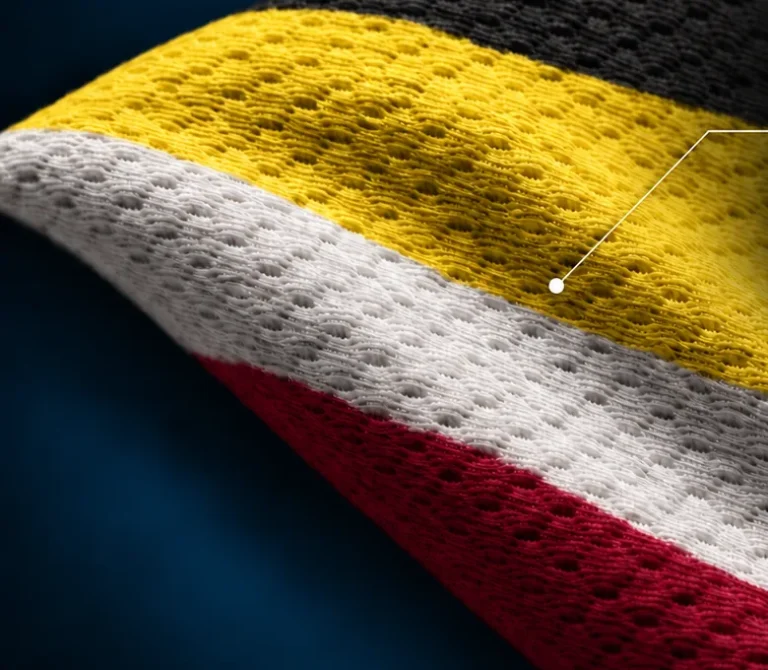
DOTTA-F is my pick for most volleyball teams. It is a 160 GSM pinhole dot mesh with a smooth face, so it breathes and prints team graphics cleanly.
- Best overall: DOTTA-F at ₹599. Small evenly spaced eyelets, wicking, UV and anti-microbial finishes.
- Best for heat: RIBRA-G at ₹599, the lightest premium fabric at 140 GSM, with stretch for fitted cuts.
- Best value: DOTTA-F at ₹599, since it gives you the finishes of the Elite fabrics for ₹100 less.
- Best budget: LINEA-S or PINDOT-N at ₹399, good for school teams and house matches.
- Best for finals and photos: QUARTZ-A at ₹699, with a clean diamond knit that looks sharp on camera at 180 GSM.
How do the 8 Jaypee fabrics rank for volleyball?
All eight are 100% polyester and sublimated. For volleyball, the ranking weighs breathability, stretch and how cleanly each knit prints.
| Rank | Fabric | Tier and price | GSM | Volleyball fit | Where it works best |
|---|---|---|---|---|---|
| 1 | DOTTA-F | Pro, ₹599 | 160 | Best fit | Indoor matches, tournaments, bold graphics |
| 2 | RIBRA-G | Pro, ₹599 | 140 | Good fit | Fitted and sleeveless cuts, summer play |
| 3 | HEXA-B | Elite, ₹699 | 160 | Good fit | Hot outdoor courts, long tournaments |
| 4 | QUARTZ-A | Elite, ₹699 | 180 | Good fit | Finals, warm-up tops |
| 5 | GRID-E | Club, ₹499 | 170 | Good fit | Club and college teams, easy washing |
| 6 | LINEA-S | Budget, ₹399 | 180 | Good fit | School sports day, first team kits |
| 7 | PINDOT-N | Budget, ₹399 | 180 | Good fit | House jerseys, practice kits |
| 8 | RHOMB-H | Pro, ₹599 | 175 | Limited fit | Travel wear and coach polos |
Volleyball is forgiving of fabric choice, which is why almost every knit scores as a good fit. RHOMB-H ranks last because its tight, matte polo feel is meant for polos and offers less stretch for arm swings.
What does volleyball demand from a jersey?
A volleyball jersey must let you swing your arms overhead, jump repeatedly and keep cool across several sets. There is no tackling, so tearing is rare, and comfort and fit matter most.
Matches go to five sets, and a long match can run past 90 minutes. Rallies are short bursts of effort, with a pause between them. Sweat builds up during the pause and the shirt stays damp. A moisture-wicking finish pulls sweat to the surface so it can evaporate, which is basic physics, and it keeps the shirt from clinging to your back when you set or spike.
Arm freedom is the main fit issue. The shoulder seam should not pull when you swing. A stretch fabric like RIBRA-G handles that well, while a mesh like DOTTA-F is soft enough that most players do not notice it.
Players are close to the net and the crowd, so the shirt gets photographed constantly. Sublimated numbers and school names stay sharp, because the ink becomes part of the fibre and cannot crack or peel. Our homepage claims the print does not fade even after 100 washes.
Which fabric is best for indoor volleyball and which for beach or sand?
For indoor halls, DOTTA-F is the best fit. For beach, sand or open grounds in the sun, choose HEXA-B or RIBRA-G.
Indoor courts have still air and bright lights. The air does not carry sweat away, so wicking matters more than UV protection. DOTTA-F gives you that and a smooth printed face under the hall lights.
Sand courts and village grounds add sun and sometimes wind. The UV finish on HEXA-B, DOTTA-F, RIBRA-G and QUARTZ-A is useful in those conditions. Sand also gets into everything. A smooth, tightly knit face such as LINEA-S sheds sand more easily than an open mesh whose cells can hold grains, so if your team plays on sand and wants a ₹399 option, LINEA-S is the better choice than PINDOT-N. Shake the shirt out and wash it in clean water after every sand game.
In Tamil Nadu, outdoor play at midday means strong sun. If your tournament runs from 10 in the morning until late afternoon, bring a spare shirt for the finals. Browse the volleyball jerseys page for design ideas.
Are sleeveless or fitted cuts better for volleyball?
Both work. Sleeveless and short-sleeve fitted cuts are the most common for spikers and setters, because they give the shoulder full range.
A fitted cut stays out of your way at the net. It also avoids the loose cloth that can brush the ball on a serve. RIBRA-G is listed for sports vests and panelled jerseys, so it is a natural choice for a fitted sleeveless top. Women’s fit is available, and the women’s jerseys page explains the cuts.
Short sleeves are comfortable for school teams. A fitted shirt does not need to be tight. Ask us for a snug but easy fit, and check the size chart for XS to 4XL, which covers 34 to 48 inch chests. Jersey and shorts can be different sizes too.
Which fabric suits setters, hitters and liberos?
Setters and hitters want maximum arm freedom and airflow, while liberos usually wear a contrasting colour. The same fabric works for all, with the libero in a different colour.
Hitters jump and swing hard, and their shoulders stretch the shirt. RIBRA-G suits them for its stretch. Setters spend the match with arms overhead, so a soft mesh like DOTTA-F or HEXA-B keeps their upper back cool.
The libero wears a different colour from the rest of the team under the rules, so you need a second colour set. Order the libero shirt in the same fabric, so it feels the same. Liberos dive and slide on the floor. A libero who plays on a hard or rough surface will like the slightly heavier 180 GSM fabrics, but on a smooth indoor floor any of these is fine.
What GSM is best for a volleyball jersey?
Use 140 to 160 GSM for match shirts and 180 GSM for school kits that get heavy use. Our GSM guide covers the full range.
Sublimated team jerseys usually sit at 120 to 190 GSM. Lighter fabric, at 120 to 150 GSM, is cooler and dries faster. Heavier fabric, at 160 to 190 GSM, feels more structured and lasts longer. A 220 GSM fabric is T-shirt or hoodie weight, which is too warm for any court.
A manufacturer article on volleyball uniform fabric from Ecojersey also points to lightweight, stretchy polyester knits for volleyball. That is a vendor view, and it lines up with our experience.
How should volleyball teams design the jersey layout?
Keep the number large on the back and small on the front, put the team name across the chest, and keep sponsor logos away from the armpit seam. A clean layout reads well from the stands and from a phone camera.
Volleyball is photographed from the side and from behind the baseline, so back numbers matter most. Because sublimation covers the whole panel, you can run a colour fade or pattern down the sides. DOTTA-F and QUARTZ-A give the cleanest printed face for patterns. The free mockup shows the layout on a front and back view before we print, and you can change it as many times as you like within the 24 hour turnaround.
Dark colours hide sweat marks, and light colours show them. Bright whites and pastel shades look good in the first set, though a long match can darken the underarm. If your team likes light colours, choose a mesh with a wicking finish so the shirt dries between rallies.
How do you care for a volleyball jersey after a match?
Rinse sand and sweat out quickly, wash inside out in cold water and dry in the shade. Skip fabric softener, which coats the fibre and slows moisture wicking.
Sand grains act like sandpaper in a washing machine. Shake the shirt out, rinse it by hand first and then wash. The anti-microbial finish on DOTTA-F, RIBRA-G, HEXA-B and QUARTZ-A helps control odour. GRID-E is easy to wash,, though it has no wicking, UV or anti-microbial finishes.
Avoid a hot iron on the printed surface, and do not leave a wet shirt in a kit bag overnight. Sublimated polyester can soften under direct heat, and a knit shirt hung properly does not need ironing anyway. Two spare shirts for a tournament weekend are worth carrying, since a dry shirt for the next match feels much better than a damp one.
How much does a volleyball squad cost?
A volleyball squad is small. Names, numbers and logo are included in the price, and the minimum order is 5 pieces.
At the listed rates before any bulk discount, twelve DOTTA-F or RIBRA-G jerseys come to ₹7,188. Twelve HEXA-B or QUARTZ-A jerseys come to ₹8,388. Twelve GRID-E jerseys come to ₹5,988, and twelve LINEA-S or PINDOT-N jerseys come to ₹4,788. Bigger orders get a lower rate per piece, and every size costs the same.
If your budget is tight, put the starting six in DOTTA-F and the rest in LINEA-S. In the same colour, the two look similar from the stands. Add one libero shirt in a contrast colour, and you are covered.
How do you order volleyball jerseys?
Send your team name, colours and numbers on WhatsApp, and you get a free mockup in 24 hours. Delivery takes 7 to 10 working days after design approval.
We deliver across Tamil Nadu, India and abroad. Compare all eight on the jersey fabrics hub, read the DOTTA-F versus RIBRA-G comparison, or ask for swatches on WhatsApp.
Fabrics in this guide
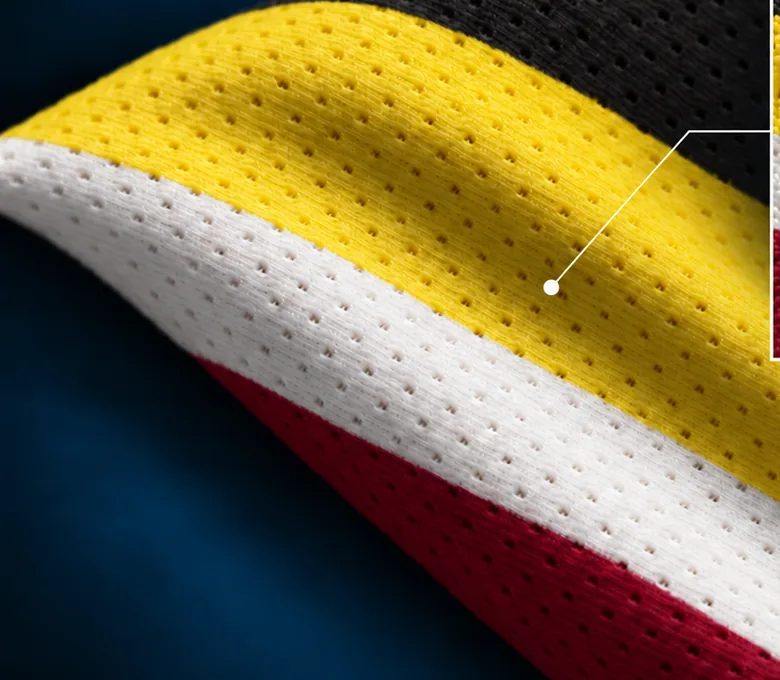 DOTTA-F Pinhole dot mesh, 160 GSM
₹599 per jersey with names and numbers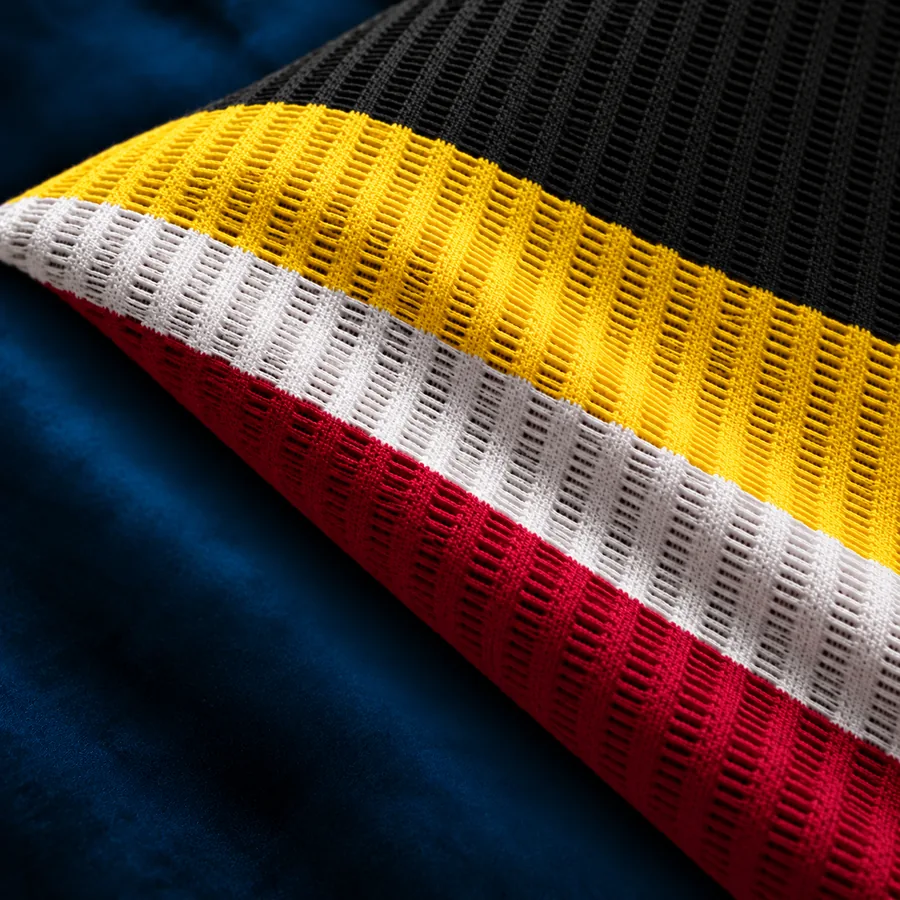 RIBRA-G Rib ladder knit, 140 GSM
₹599 per jersey with names and numbers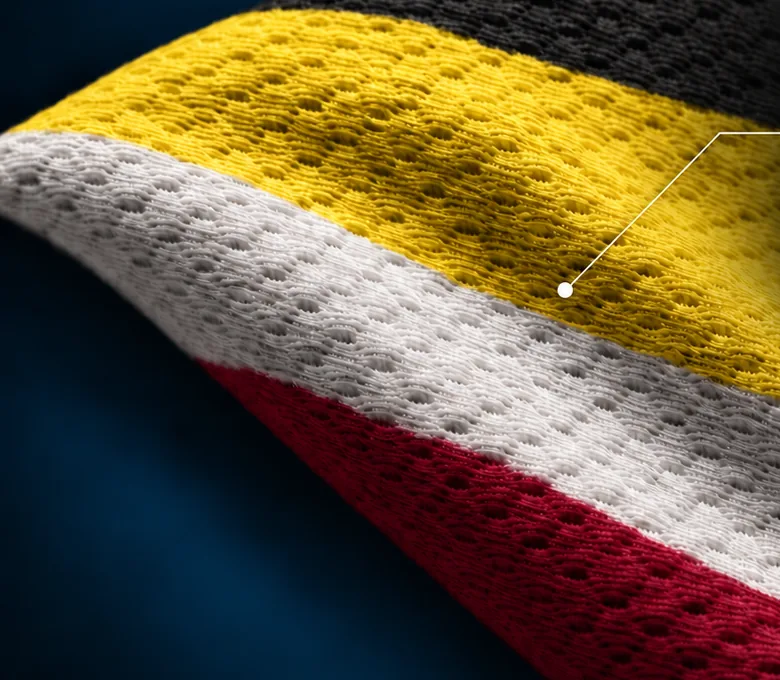 HEXA-B Football mesh, 160 GSM
₹699 per jersey with names and numbers LINEA-S Micro grid knit, 180 GSM
₹399 per jersey with names and numbers
Frequently asked questions
What is the best material for a volleyball jersey?
Lightweight polyester is best. DOTTA-F, a 160 GSM pinhole dot mesh at ₹599, breathes well, wicks sweat and gives a smooth face for team graphics.
What GSM is best for volleyball jerseys?
About 140 to 160 GSM suits match shirts, since volleyball needs airflow and free arm swings. Use 180 GSM for school kits that get heavy use.
Are volleyball jerseys sleeveless?
Many are sleeveless or short sleeve with a fitted cut, which gives shoulders full range. RIBRA-G is listed for sports vests and fitted panelled jerseys.
Which fabric is best for beach volleyball?
HEXA-B or RIBRA-G handle sun well, and both carry UV protection. A smooth knit like LINEA-S sheds sand more easily than an open mesh if budget matters.
Do liberos need a different jersey?
Yes. The libero wears a contrasting colour to the rest of the team. Order it in the same fabric as the squad so it feels identical.
How much does a custom volleyball jersey cost?
Jaypee volleyball jerseys cost ₹399 to ₹699 each depending on fabric, with names, numbers and logo included. The minimum order is 5 pieces.
Get Your Free Quote
Tell us about your team kit. We send a free design mockup on WhatsApp within 24 hours.
Or WhatsApp us directly: +91 95003 97105
Watch Our Custom Jerseys
See real Jaypee Sports team kits in action. Tap to play.